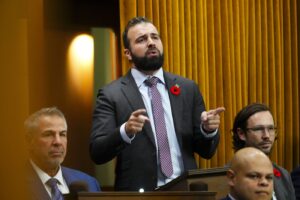
VANCOUVER — The chiefs of four British Columbia First Nations are telling Conservative MP Aaron Gunn to “chillax” after he criticized land acknowledgments spoken before public events.
In a joint statement, the chiefs from the Tla’amin, Homalco, K’omoks and Klahoose nations say “harmless” land acknowledgments only recognize “the history of the place” where people are holding events.
The nations say land acknowledgments “have never seized private property, cancelled a mortgage, repossessed a pickup truck or altered a single title deed anywhere in Canada.”
North Island-Powell River MP Gunn had criticized the practice of land acknowledgments on Monday., saying on social media that the federal government should stop making them if it “truly believes in the private property rights of Canadians.”
He was commenting in the wake of a rights acknowledgment between Ottawa and the Musqueam First Nation in B.C. that was signed last month.
The Tla’amin, Homalco, K’omoks and Klahoose nations are located in the Vancouver Island riding represented by Gunn.
“Chiefs from four First Nations communities are urging the public to please approach Aaron Gunn with no caution whatsoever,” their statement issued on Wednesday says.
“He is completely harmless, though momentarily unsettled by the alarming possibility that someone might acknowledge the land before a meeting.”
It says the chiefs “had two words for the MP — chillax, bud.”
“No one is going anywhere. Canada will survive the brief moment of honesty. Until then, chiefs across the region continue to reassure the public that land acknowledgments have not, to date, resulted in any land back.”
Gunn says in his statement that a land acknowledgment “reinforces the radical and dangerous legal concept that most Canadians live on ‘stolen land.'”
“This is Canada,” he says. “One country. For all Canadians.”
The agreement with the Musqueam, who claim Aboriginal title of an area spanning much of Metro Vancouver, says the First Nation has unextinguished rights and title in its territory, and that both the federal government and the Musqueam are seeking a “new nation-to-nation, government-to-government relationship.”
The rights agreement says it does not “create, amend, establish, abrogate or derogate” from Musqueam title, and nor does it constitute a treaty or land claim.
This report by The Canadian Press was first published March 12, 2026.
The Canadian Press