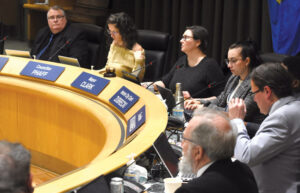
City councillors will discuss spending close to half a million dollars to expand its role in the Energy Innovation Challenge after already spreading $850,000 since 2023.--NEWS FILE PHOTO
bmiller@medicinehatnews.com
Next Monday city councillors will consider extending a program which seeks to find innovative solutions for accelerating energy transitions that are tested in Medicine Hat, with a price tag of close to half a million dollars.
In 2023 the city contributed a share of $850,000 to host the Energy Innovation Challenge in collaboration with Decentralised Energy Canada and other partners including Prairies Economic Development, APEX Alberta, Emissions Reduction Alberta and Natural Resources Canada.
The goal of the project is to support innovative solutions created by small and medium-sized Canadian businesses to address four focus areas; grid reliability, grid resiliency, energy affordability and sustainability.
For the city’s contribution of $850,000 to the total $2.4-million project, five successful applicants were invited to Medicine Hat to demonstrate small-scale pilot projects.
An example is Edmonton’s Aqua-Cell Energy Inc. which was able to instal a prototype battery storage facility at a west-side gas station that uses large saltwater flow batteries to store renewable or off-peak energy for use during peak demand periods or outages.
In 2023, the City of Medicine Hat had expectations of retaining ownership of the assets and innovations and intellectual property developed through the projects that could be used at a later time at the discretion, however negotiations on this issue have since failed.
Recently, Decentralised Energy Canada reached out to the city expressing an interest in expanding the program for another 18 months to allow for an additional intake of applicants for between two to three demonstration projects.
However, to support the extension of the project the city is being asked to provide an additional $460,000 in the form of a budget amendment from the electric distribution operating expenses.
Staff say Medicine Hat has received positive attention since its participation in the Energy Innovation Challenge and are recommending councillors approve the ask.
“We do fully recognize that there is opportunity for broader reputational and potential investment attraction opportunities that could come with continued participation in a project like this,” said Rochelle Pancoast, managing director of energy, land and environment.
At the next open council meeting Mar. 16, city staff will present the motion for consideration to a council facing an approximate $9-million budget gap that needs to close by 2028.
Coun. Bill Cocks asked what Medicine Hat would receive in return for the $460,000 that would go directly to the innovators.
“We would be net contributing financially, we would gain some learnings by being present and experiencing some of those early learnings across some of the solutions,” said Pancoast, who cited a software solution that would suggest best places to instal batteries if they were added to the city’s electrical distribution system to best minimize congestion.
“In the process we’ve also recognized there could be an opportunity to leverage that to help plan outage optimization,” said Pancoast.
Coun. Stuart Young acknowledged benefits of the program and its alignment with the city’s strategic planning, however shared hesitancy over the price tag.
“How I see this is in terms of a hockey rink,” said Young. “Like, we have the most amazing hockey rink and everyone wants to do their experiments, but we’re also paying them to come and do their experiments.
“Now of course, if something great happens from that, we can reap the benefits of that,” said Young, who said he believes council will need more evidence of the financial benefit before accepting to expand the project.
“I think it’s going to be a challenge for council to go, ‘Hey, we want to put more money into this when we’re not exactly sure of the benefit that we’ve received now.'”
The winning pilot projects so far will be implemented in the Hat until September when final reporting will begin on GHG savings, project results and impacts.