A Quebec student pilot will head to court this month after his plane crashed during a “solo flight” with a friend as a passenger.
Jean-Frédéric Pinard-Decelles, who was 30 years old at the time, was charged with criminal negligence and dangerous driving of an aircraft. His trial is set for March 16 at the Longueuil, Que., courthouse on Montreal’s South Shore.
According to an incident report by the Transportation Safety Board of Canada, Pinard-Decelles owned a Cessna 150G, which he used during his flight lessons.
On April 21, 2023, Pinard-Decelles let his instructor know he was about to fly via text message and the instructor approved the solo flight. His instructor was not physically present.
Weather conditions were good for flying and the student had sufficient hours to be allowed to fly solo.
Pinard-Decelles brought a friend with him on the flight, according to the report.
An hour after taking off, the plane was seen flying at low altitude over a residential area near Saint-Rémi, Que., about 32 kilometres south of Montreal, where a group of about 15 people were having an outdoor gathering on a private property.
One of the attendees recognized the plane and had a 21-second video call with Pinard-Decelles asking him to put on a “show,” according to the TSB.
The plane approached flying nose-up, executed an unidentified manoeuvre, and ended up in a vertical descent.
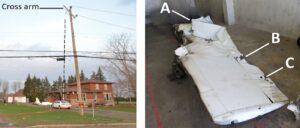
The plane severed power lines before crashing onto the roof of a car parked in the driveway of a house near the gathering and bursting into flames.
Several people rushed over to help the student pilot and passenger, who were both seriously injured and taken to hospital. The fire spread to the house and firefighters were called to put it out.
No one else was injured.
According to the report, no distress signal was sent and the TSB said it was impossible to establish whether any deficiencies were identified with the aircraft.
However, it said pilots should never fly over a built-up area or an open-air assembly of people at an altitude lower than 1,000 feet above the highest obstacle, except for takeoff and landing.
Pinard-Decelles would have been flying over a residential area and a group of 15 or so persons at less than 500 feet above ground level.
The report indicates the plane stalled, meaning its speed dropped below the minimum needed to create enough lift to stay in the air. Planes must be at a high enough altitude to recover from a stall.
The TSB says Pinard-Decelles’s instructor, who approved the solo flight, was the founder and chief instructor of the flight school Ikaros.
However, the instructor had his flight training unit operator certificate revoked on Feb. 23, 2023, at Ikaros’s request, after the school’s only aircraft was destroyed when the hangar it was stored in collapsed. He continued to give flight training lessons on a freelance basis.
According to the TSB, there are several conditions to a student’s solo flight, including that the flight be for training purposes, be conducted under the direction and supervision of a person qualified to provide training and that no passengers be on board.
The report says that in the months preceding the incident, Pinard-Decelles was regularly flying for his own pleasure and often provided no directives or exercises to practice in flight. The student pilot also regularly took a passenger on solo flights without notifying his instructor.
He began learning to fly in January 2022 and started solo sessions in June of that year. At the time of the crash, he had 163 hours of flying under his belt, including 20 hours of dual instruction and 142 hours of solo flight.
Though Transport Canada allows for remote supervision of student pilots, it stresses it is “not a good practice” and should only be done occasionally.
The TSB points out that Transport Canada does not require freelance instructors to notify it of their training activities, “making regulatory oversight of these instructors difficult.”
The agency investigates formal complaints or when inspectors become aware of incidents occurring during training, trusting freelance instructors to comply with regulation.
This report by The Canadian Press was first published March 4, 2026.
Erika Morris, The Canadian Press