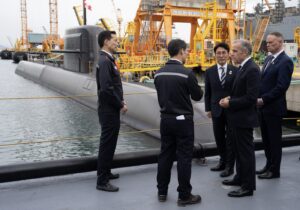
OTTAWA — The competition to build the Canadian navy’s next fleet of submarines is heading into a new phase after a deadline for both finalists to submit their final proposals to the federal government on Monday.
Canada is planning to buy a fleet of up to 12 conventionally powered submarines with the hope of having the vessels in the water by 2032.
The multibillion-dollar procurement is happening at an accelerated pace as the Royal Canadian Navy’s aging Victoria-class submarines are set to retire in the next decade.
The two bids are from South Korea’s Hanwha Oceans and ThyssenKrupp Marine Systems, or TKMS, in a bid that includes Germany and Norway.
Stephen Fuhr, the secretary of state for defence procurement, said in February that Ottawa will likely announce a winner this year.
TKMS CEO Oliver Burkhard said he expects a decision to be made by mid-year, a timeline he called “very ambitious” given that 18 months ago Canada was talking about making a decision by 2028 or 2029.
Burkhard, who sat down with Canadian reporters for interviews on Monday in Ottawa, said his firm isn’t releasing details about its pitch such as the cost and job creation estimates, though he said there is a plan to deliver at least two submarines to Canada by 2034.
The Liberal government has made it clear that its decision will rest in part on which proposal provides the most economic and industrial benefits in Canada.
Burkhard said that requirement, which is “due to the behaviour of your southern neighbour,” puts pressure on both bidders.
“I think there’s a lot in this new world order and this new (geopolitical) and security environment which we are living in where mid-nations like ours — Germany, Canada, Norway — have to join their forces,” he said.
Industry Minister Mélanie Joly has said she wants to see Canada expand manufacturing from South Korean and German automakers.
Burkhard said he understands the demand from the Canadian side, but “I wouldn’t put all eggs in one basket and say, ‘If we don’t have an automotive production, then it’s not good for Canada.'”
Canadian officials have visited the shipyards in South Korea and Germany, and officials from both countries have also visited Canada.
Hanwha and South Korean officials have framed the submarine contract as a starting point for a deeper industrial relationship between Canada and Korea.
Charlie SC Eoh, president of Hanwha Ocean, said the commitment to a deeper relationship with Canada is not limited to a single procurement decision, but added it “would be a major accelerant.”
He said the proposal would include investments in sectors including steel, AI and space and Hanwha estimates that would spur the creation of 25,000 jobs a year between 2026 and 2044.
Hanwha is pitching that it will deliver the first submarine by 2032 and four by 2035, with what the company calls a “firm price estimate,” though it declined to publicly put a number on that estimate.
“In short, this is not just a platform pitch,” Eoh said in a written response to questions.
“It is a risk-eliminated delivery plan paired with a generational industrial partnership that seamlessly aligns with Canada’s Defence Industrial Strategy.”
Hanwha is also interested in other contracts with Canada, he said, including land defence programs, electronics and AI technologies and Arctic capabilities.
“We have built strong relationships with highly capable Canadian companies, and we intend to grow those partnerships regardless of the outcome,” he said.
Both firms have signed agreements with a raft of Canadian companies to co-operate on work on the subs, should they win the contract.
They have also had a visible presence in Canada in recent months.
Hanwha has taken out bus shelter ads throughout downtown Ottawa and is running a large digital ad campaign, an unusual move aimed at making the company a household name.
That includes ads Burkhard spotted at the Ottawa airport.
“I mean, the people landing there coming from Fort Myers, Cancun or somewhere else, they don’t buy a submarine,” he said, adding he’d prefer to put that kind of money into research and development.
TKMS is the main sponsor of the Conference of Defence Associations Institute’s annual conference in the capital this week.
Tom Lawson, chair of the institute’s board and a former chief of the defence staff, said Canada has cut years off the procurement process.
This kind of speed is precisely what the industry wants to see from the federal government as it implements its new defence industrial strategy, Lawson said.
“It starts the momentum, maybe we see a self-reinforcing upward spiral that works for the military and works for defence industry,” he said.
Lawson said the accelerated timeline on the submarine deal is helpful to both companies. While both want to win, he said, they are also sorting out future plans if they don’t.
“I don’t think, for either of them, that the competition’s existential. TKMS is going to have some other submarines to build for other countries. So is Hanwha,” he said.
But with billions of dollars on the line, Lawson said both will be pitching hard.
This report by The Canadian Press was first published March 2, 2026.
— With files from Kyle Duggan
Sarah Ritchie, The Canadian Press