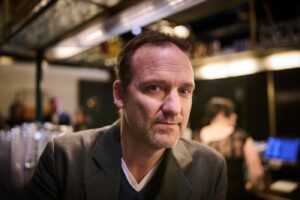
TORONTO — Alexandre Trudeau decided long ago he wouldn’t follow his father, Pierre Elliott, or his brother, Justin, into public office.
“I’ve seen politics from all sides. I grew up with it. I’ve been more interested in storytelling, which in a way, is a deeper, perhaps even more effective way to change people’s lives,” he says during an interview in Toronto.
“I’m not the political type. For one, I never care what people think of me. That doesn’t make for a very good politician.”
Nor, he adds, is he suited to the compromises the job demands.
“I’m not much for adjusting one’s beliefs because they would be more popular. None of that makes sense to me.”
Instead, he chose filmmaking — though he hardly strayed from political terrain. He’s spent most of his career directing incisive documentaries, from covering the 2003 invasion of Iraq in CTV’s “Embedded in Baghdad” to chronicling Sudan’s humanitarian crisis in 2008’s “Refuge.”
But with his latest project, “Hair of the Bear,” Trudeau is stepping into fiction for the first time. Out Friday, the Canadian thriller stars Malia Baker as an anxiety-ridden teen sent to stay at a remote cabin with her grandfather, played by Roy Dupuis. When unwelcome outsiders arrive, she’s forced into a fight for survival and, ultimately, for a sense of herself.
The story grew partly out of concerns he and co-writer James McLellan shared about rising anxiety among young people — a theme that unfolds against the frigid wilds of northeastern Manitoba.
Even in fiction, though, Trudeau can’t quite shake the political. He says the film’s marauding antagonists mirror the repeated threats to Canada’s sovereignty from U.S. President Donald Trump.
“Our film is a bit of a metaphor for that — being weaker, smaller and younger doesn’t mean you lose the fight,” he says.
“And also, the message behind anxiety is you’ve got to fight for your life.”
That reading, he suggests, naturally extends to Canada’s place beside a turbulent superpower.
“It’s a border story… There are many ways of seeing it — young people needing to fight for their lives, and a country needing to stand up for itself.”
McLellan, who teaches film production at a Winnipeg high school, says he started noticing an inordinate amount of his students suffering from emotional distress during the 2010s.
“I distinctly remember seeing so much self-harm on their wrists,” he says, adding he still sees it today.
“It’s different than suicide. It’s like a paralysis — like, scratching at yourself. It’s self-hatred, all types of things that were consuming these kids.”
He believes it reflects the overlapping pressures facing young people today. While he resists blaming any single factor — “it’s not just their cellphones” — he points to a steady barrage of stressors, from social media to economic uncertainty and the rise of AI.
“There’s just so much noise in the heads of kids nowadays,” he says.
The issue hits close to home for both filmmakers, who have teenage children. But Trudeau admits he was initially skeptical.
“Growing up, anxiety wasn’t a problem for me,” he says. “I didn’t really believe James at first because I don’t teach like him so I’m not exposed to it, apart from my own kids.”
Raised on adventure and intense travel, Trudeau says he’s tried to instil that same resilience in his children through experiences like whitewater canoeing.
“The kind of things that help calibrate your stress engines,” he says.
That inclination towards motion over rumination, he suggests, is something he and his brother Justin Trudeau still share.
“Sometimes when I go over to his place, we’ll watch something together. But we don’t talk about film. My brother and I have the most playful relationship possible, so we’re more likely to wrestle,” he says.
“Together, we’re men of action more than talk.”
But if the subject turns to tensions between Canada and the U.S., Trudeau certainly isn’t lacking for words.
Having reported from Baghdad during the U.S. invasion of Iraq in 2003, he says he long ago concluded that “the great republic to our south was deeply damaged.”
“I saw countless people’s lives ruined by a lie,” he says of the war. “We all know it was a lie. There was no threat that justified it — and it seems to have been forgotten. But that woke me up a long time ago.”
For Trudeau, threats to Canada’s sovereignty from Trump feel like a continuation of forces he has been watching build for decades.
“It surprised a lot of Canadians,” he says. “But I’ve been up for hours.”
Still, he resists pessimism. While liberal democracies may be “crumbling” elsewhere, he argues Canada remains resilient.
“We’re still so lucky to be a tolerant, pluralist, united country,” he says. “It reminds me not to take this place for granted. We’re the last person standing for the things we want to believe in — individual freedoms, rule of law, transparent government.”
He connects that idea to the film’s premise: a lone survivor fighting back.
“Unlike so many Western nations that once stood as examples of freedom and justice, we’re still going strong.”
This report by The Canadian Press was first published March 2, 2026.
Alex Nino Gheciu, The Canadian Press