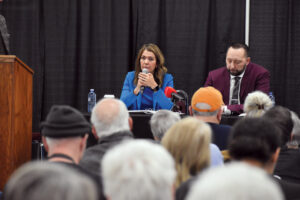
Brooks-Medicine Hat MLA and Premier Danielle Smith responds to questions with Cypress-Medicine Hat MLA Justin Wright at their biannual town hall event Saturday.--News Photo Zoe Mason
zmason@medicinehatnews.com
At a constituency town hall event Saturday morning, Medicine Hat’s two MLAs expressed their views on separation after the premier told reporters last week the referendum question on Alberta independence could be added to the ballot this October.
In response to a question asking the two MLAs to clearly state their stance, both Smith and Wright said they did not identify as separatists.
“I’m not a separatist, but I will not denounce anybody who’s lost hope in Canada,” she told the room of about 150 constituents. “I think my job is to restore that hope.”
Smith said the federal government’s “death bed conversion” – her description of Ottawa’s substantial policy changes under the leadership of Prime Minister Mark Carney – has been a good faith measure to show Albertans they’re willing to play ball.
She says she thinks it would be enough to quash a referendum question on independence, if it should get that far.
“At the moment, I would say if it is the case that they get the number of signatures, I think remaining in Canada would be the result.”
But the premier says there are certain conditions she thinks could change that outcome, including the federal government “reneging” on the November memorandum of understanding or continuing to push an unpopular gun buyback program.
“If the will of the people wants to secede, do you support that? It’s a yes or no question,” asked one participant. He did not receive a reply.
The familiar boogeyman of Justin Trudeau was raised several times throughout Saturday’s session. Smith credited the former prime minister with creating the independence movement.
“I told Prime Minister Mark Carney … he can address it by addressing some terrible policies of the last 10 years.”
Wright initially demurred from providing a clear answer, but under pressure from Southeast Alberta Chamber of Commerce president and event moderator Aaron Fleming, he expressed a similar stance.
“I think Canada can work,” he said. “People just disregard the fact that I’ve said I think Canada can work. We need to make sure that we’re doing it in a respectful way, period.”
He likewise expressed sympathy for frustrations represented by the separatist movement.
“I’m not going to shut down any form of discourse. We need to be able to have these conversations,” he said.
Attendance at Saturday’s town hall was notably lower turnout than previous events hosted by the pair.
Judging based on applause, most attendees were in favour of the measures the premier outlined in last Thursday’s address and is putting to referendum in October.
Referendum questions cover topics ranging from immigration to constitutional changes, including the abolition of the federal senate and introducing the ability for provinces to opt out of federal programs related to provincial areas of jurisdiction, like health and education.
About 30 protestors were gathered outside Higdon Hall at the Stampede Grounds brandishing Canadian flags and signs calling for recall of the premier. There are still two weeks remaining in the signature collection period for the citizen initiative petition attempting to unseat Smith.
So far, at least eight completed recall petitions have failed.
A few vocal opponents were ejected from the event before the question period began. One constituent was escorted out while shouting about the UCP government’s use of the notwithstanding clause four times during the last legislative session.
Smith explains next steps should Albertans support
constitutional Qs
At an unrelated press conference Monday, Smith expanded on what would happen next should the four constitutional questions that will go to referendum generate the support of Albertans.
She said according to her own interpretation of section 95 of the constitution, her government has the power to assume greater control over immigration policy.
She says this power has already been affirmed by the precedent of the Canada-Quebec Accord, which granted Quebec greater power over its immigration policy in 1991.
“If there is any kind of constitutional discussion, I guess we can battle it out in the courts, but it’s already been a well established thinking back since 1991 that they do have the right to do it,” she told reporters Monday.
The constitutional questions on the ballot ask Albertans to direct provincial policy on a number of matters that affect what Smith has often referred to as Alberta’s “sovereignty within a united Canada.”
During Saturday’s town hall, she compared the relationship she seeks between Alberta and Ottawa to the relationship already in place between First Nations and the federal government.
“Our First Nations are sovereign entities, but they’re Canadian as well. Within the boundaries of their reserve, they get to create their own laws, and the federal government doesn’t interfere with their business in their jurisdiction. That’s what we want,” she said.
She expanded Monday on the extent to which Alberta is in a position to affect those changes.
Smith said the abolition of the federal senate would require unanimous agreement among all provinces and the federal government. She says the questions asserting that provincial laws take precedence over federal laws in areas of provincial jurisdiction would require amendments endorsed by seven out of 10 provinces, representing 50 per cent of the population.
Opting out of federal programs while retaining federal funding is an issue Smith says would require further negotiation with Ottawa.