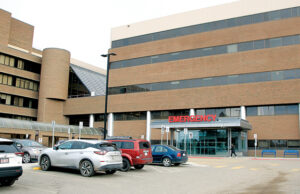
As a measure to address an ongoing health crisis in a number of Alberta emergency departments, the provincial government announced in January plans to hire triage physicians at six hospitals. At the time, critics suggested doctors would hard-pressed to take on such a role for various reasons, and to date none of those positions have been filled. The UCP government has yet to respond to requests from media about the process.--NEWS FILE PHOTO
zmason@medicinehatnews.com
One of the stop-gap measures announced by the Alberta government to tackle crisis conditions in the province’s emergency rooms has quietly failed to launch.
At a press conference Jan. 15, Minister of Hospital and Surgical Health Services Matt Jones announced the triage liaison physician role in six key hospitals across the province. The measure was introduced to help expedite care in the province’s overwhelmed emergency rooms following the death of a 44-year-old father in an Edmonton ER on Dec. 22.
In a conversation with the News on Jan. 23, Alberta Medical Association president Brian Wirzba said he doubted any doctors would sign on for the role. In an interview Friday, he said that to his knowledge, none have.
CBC reported this week that despite seven requests over two weeks, the ministry would not confirm whether any of the triage physician roles had been filled.
In a statement to the News, the Ministry of Hospital and Surgical Health Services also failed to confirm whether any doctors were working in the role.
“The work to recruit for the triage physician liaison role is ongoing,” said Kyle Warner, the press secretary for the ministry. “Our focus is ensuring the role is filled as rapidly as possible to improve care for patients and families.”
Warner said recruitment is ongoing for the first phase of the initiative, which includes Foothills Medical Centre, Grey Nuns Community Hospital, Peter Lougheed Centre, South Health Campus and University of Alberta Hospital.
The News contacted Alberta Health Services, Covenant Health and Acute Care Alberta for comment about the status of the triage physician role. They all referred the inquiry to HSHS.
Physicians have declined to sign on to the triage physician role for a number of reasons, Wirzba says, including outdated pay structures and vulnerability to liability. They are issues both he and president of the section of emergency medicine Dr. Warren Thirsk want to resolve. But they say negotiations have been essentially nonexistent.
The relationship between the AMA and the province was damaged by the government’s decision in 2020 to unilaterally discard the physician compensation agreement.
Today, Wirzba says the relationship is “reasonable.”
Wirzba himself has been in contact with both Jones and Minister of Primary and Preventative Health Services Adriana LaGrange on the question of the triage physician role. But Thirsk says he and his members have been shut out of communications with the government.
After an informal discussion between Wirzba and the health ministers, Thirsk says he was invited to send the minister a solution. He sent a document outlining points of action that would address some of the doctor’s concerns.
The minister emailed to say he was passing it on to his team, and that was the only communication Thirsk received.
Thirsk’s suggestions included updating physician compensation to meet the minimum rate an emergency physician will typically see, a pay bump of about $40 from what is currently being offered.
“This is not money for a government,” said Thirsk. “This is not a money fight.”
Other modifications suggested by Thirsk include dropping antiquated accountability measures that pre-date the electronic medical records system to reduce administrative red tape, and acknowledging that the role asks physicians to take on more overtime.
Thirsk says he crunched some numbers in his message to the ministry and found the role as announced would require 24 new doctors. The ministry has said staff for this position would initially come from the existing pool of personnel. Thirsk says many emergency physicians are already taking on several extra shifts per month to meet staffing demands.
“‘Acknowledge,’ that was the term I used. ‘Acknowledge overtime aspect of this work.’ Not a big ask. I didn’t even put a dollar value down.”
Thirsk says he also asked the government to acknowledge the inherent legal risk in asking physicians to assume responsibility for patients they may only see for minutes in overcrowded, under-resourced waiting rooms.
“We didn’t create the crisis. I haven’t failed to build hospitals, I haven’t failed to train nurses. I haven’t failed, but you want to throw me in and risk facing a judicial inquiry for that failure.”
In a January interview with the News, chief medical officer of ACA Aaron Low said he interpreted the AMA’s resistance to the terms of the triage physician agreement as proposed were motivated by AMA aspirations to improve physician compensation outside the normal negotiation process.
“AMA often seeks opportunities to bump up rates in between contracts, and this is, from my perspective, what might be happening here. This is a highly public ARP (Alternative Relationship Plan), something that we really want to do from a patient care perspective,” he said.
“It may be seen as an opportunity to bump up physician rates outside the normal process, which is between the AMA and the government. The AMA knows that. Doctors know that.”
Wirzba and Thirsk staunchly deny that interpretation.
Wirzba says the methodology for calculating standard clinical ARP rates was agreed to in the last round of negotiations with the government, although it was never signed off on by the province. Rather than use that methodology, the triage physician agreement follows a rate-setting formula from 2002.
Thirsk says he needs a chance to represent his section’s concerns before he can endorse the agreement in good faith.
“It’s a conversation that has not occurred that needs to occur so I can go back to my membership and say, ‘We know this isn’t great. We know you’re stepping up. Here’s the protection we can give you.’ That’s my duty as the AMA person.”
The AMA has since advised its members not to sign on to triage physician role, despite believing it is a measure with potential to provide some relief to over-burdened ERs.
“The AMA has not had the chance to talk, negotiate, or advocate for any of our membership.”
Thirsk says he resents the implication that physicians aren’t willing to step up.
“There has been an attempt to frame this as the doctors aren’t willing, or the doctors don’t want to do the job. And that’s frankly untrue,” Thirsk said.
Wirzba added that the negotiating process has been further handicapped by the health-care refocusing, which has severed the authority for financial aspects and agreement terms between two ministries, HSHS and PPHS.
“Needless to say, physicians are a little frustrated. How do you negotiate with two different ministries? Especially when you know they’re linked? It’s not just financial. It’s not just terms.”
The master agreement between the province and the AMA that was eventually arrived at in 2022 is set to expire this spring, sending both parties back into negotiations.
Wirzba says he hopes failure to reach an agreement on the triage physician position does not foreshadow upcoming negotiations.
Thirsk is not optimistic.
“I can only speak for my section, but our membership is feeling deeply unheard and trampled on.”
The UCP have attacked healthcare just like trump, harming all of us. The UCP have attacked education just like trump, harming all youth in the public education system and benefitting the private schools. The Alberta Chamber of Commerce has warned us that the UCP separation crisis is chasing away investment, just like trump has chased away investment. The UCP have divided Albertans, just like Epstein’s best friend has divided Americans. The UCP are Maple MAGA, and their harm will echo across generations, just like the president that the premier and her separatists are colluding with against Canada.








The UCP have attacked healthcare just like trump, harming all of us. The UCP have attacked education just like trump, harming all youth in the public education system and benefitting the private schools. The Alberta Chamber of Commerce has warned us that the UCP separation crisis is chasing away investment, just like trump has chased away investment. The UCP have divided Albertans, just like Epstein’s best friend has divided Americans. The UCP are Maple MAGA, and their harm will echo across generations, just like the president that the premier and her separatists are colluding with against Canada.