PHOTO COURTESY DOUG HANSEN
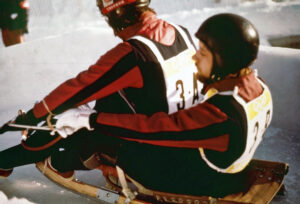
Doug Hansen (rear) and Larry Arbuthnot innovated a new technique where both sliders could generate momentum off the launch. The pair of Hatters competed at the 1972 Olympics.
zmason@medicinehatnews.com
This week, Team Canada competed in luge in the Winter Olympics, like they do every four years. The Canadian sliders didn’t medal – the honours went to the usual suspects, alpine European countries where luge is a much more established sport, like Germany and Italy.
For many Olympics viewers, it was just another event on the television, and an unremarkable one at that. But for two Hatters, it’s a walk down memory lane.
Poul Nielsen and Doug Hansen have known each other for decades. Both originally from Standard, Alta, they’ve both settled in the Hat. But the history they share has taken them all over the world as one-time world-class luge athletes, including a trip to the Olympics together in 1972.
Although luge has been around since the 19th century, it’s original popularity and it’s persisting locus is in the mountains of Europe. It didn’t find it’s way across the Atlantic until the mid-20th century, where Nielsen, a university student in Missoula, Mont., found himself on the vanguard.
The University of Montana acquired the continent’s first luge track in 1966. Friendly with the guys in the luge club, Nielsen picked up the sport.
As an athlete and a hobbyist, Nielsen loved to go fast. It was the crushing speed that drew him into luge.
“It takes a certain kind of mentality,” he said. “I was a rodeo rider, and then I discovered motorcycles – I just always liked doing that edge stuff,” he said.
“I remember the first runs, I’d get to the bottom breathing hard, just freaked out from the speed. We were doing 140 kilometres an hour. You go into an S-turn and it was like a shotgun.”
Travelling at such a high velocity, Nielsen and Hansen say steering a luge is a delicate affair. Just the tap of foot or the press of a shoulder on the rail will guide the trajectory of your turn. Sometimes a simple shift of the body’s weight is all that’s needed to steer the sled.
By 1970, Nielsen had raced in the North American championships, and had travelled to Europe to train. He decided to invite his good friend Hansen over drinks.
“He said, ‘I’ve been involved in this sport called luge, and I’m gonna go to Europe in the fall and train. If you’re not doing anything, why don’t you come?'” laughed Hansen.
Hansen knew nothing about the sport before heading to Europe. When he got there and gave it a go, he says he scared himself so badly he bailed on training in Germany and went to visit family in Denmark. But as he began describing the sport to them, he realized he wasn’t done with the adventure yet.
He says his future teammates were concerned by his lack of experience, but he quickly began to feel comfortable. He went back to Europe for the following training season.
“It’s an amazing feeling, when you get in a curve and you’re experiencing three Gs, you feel yourself being pushed into the sled, and it’s like, ‘wow, this is comfortable,'” said Hansen.
At a particularly challenging European Championship in 1972, one luger from the Polish team crashed his sled, sustaining serious injuries. Hansen was the next to race.
“I was doing okay, I was handling it okay. I went around S-curve one, S-curve two, and I could see into S-curve three, a pair of sled tracks going straight up the wall,” he said.
The Canadian team was the only one in which every member completed the track. When the race was over, team captain Larry Arbuthnot told the team they’d qualified for the 1972 Olympics in Sapporo, Japan.
They took a plane with 54 Canadian athletes – the entire delegation – from Vancouver to Sapporo, kicking off two weeks of contest and camaraderie.
“The opening ceremony was something I’ll never forget,” said Nielsen. “Just two dumb farm boys from Standard, Alberta.”
“Put your cowboy boots away!” added Hansen.
“Get rid of those spurs! They’ll only slow you down,” said Nielsen.
In Sapporo, the two tell stories about trying on medals from other Canadian champions and sharing drinks with members of their opposing teams.
“You were meeting athletes from around the world and finding hey – they’re people just like you. We’re not out to shoot each other. We’re just competing, and it’s honourable. You beat me, I salute you. That’s what I love about the Olympics.”
After the 1972 Olympics, Nielsen went back to school, pursuing his primary passion as a painter.
Hansen stuck around longer, even leaving a lasting mark on the sport he stumbled into.
At the Sapporo Olympics, Hansen and his teammate Arbuthnot also competed in the doubles event. Watching other teams, Hansen saw that the driver of the doubles would start the sled, while his teammate was essentially dead-weight. The team devised a trick using skate laces to tie the teammates hands together so lugers could start the sled.
After they did it in competition once, other teams began picking it up. Hansen is often credited with changing the way lugers launch, a crucial part of a slider’s success.
Hansen went back for a second Olympics in 1976. But the highlight of his career was not as a competitor but as a coach, when Miroslav Zajonc, a Czech-defector turned athlete under the Canadian flag, pulled off a massive upset and won the 1983 World Championships.
As world-class lugers, the two got to see much of the world, from training in Europe to competing in Asia. They even found their way behind the Iron Curtain, as one of three teams invited to compete in East Germany beneath the watchful eye of Vladimir Putin’s KGB.
The television sitting across from Hansen and Nielsen as they spoke to the News had the Olympics playing. On the screen, a new generation of Canadian athletes were competing not far from where they once trained.
They are aiming for glory, like Hansen and Nielsen once were. As Olympians, the two never medalled. But looking back now, maybe they gained something greater.
“By the time we were 25, we’d both been across the Pacific a couple times,” said Nielsen. “We’d travelled throughout Europe. It was crazy. It was great. Sometimes Doug and I will sit and say, ‘Did that really happen? Did we really do that?’ It seems like a dream.”