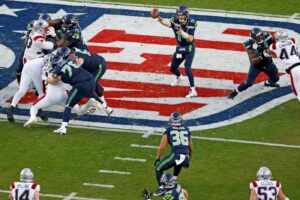
Drake Maye will try to become the rare QB to get back to Super Bowl and win after losing debut
By Canadian Press on February 11, 2026.
SANTA CLARA, Calif. (AP) — Drake Maye has a long career ahead of him to try to bounce back from
flopping in his Super Bowl debut.
The second youngest quarterback to start in a Super Bowl committed three turnovers, took six sacks and couldn’t get the New England Patriots on the scoreboard until the fourth quarter of a
29-13 loss to the Seattle Seahawks on Sunday.
While the 23-year-old Maye should have plenty of chances down the road to get back and win on the NFL’s biggest stage, history shows that’s not quite as easy as it may seem.
Dan Marino, the only quarterback younger than Maye to start a Super Bowl — by 35 days — never got back after losing his Super Bowl debut to San Francisco following the 1984 season.
That’s more typical as only seven of the 36 quarterbacks before Maye to lose their first start in the Super Bowl, eventually made it back there as a starter with only four winning it all.
Jalen Hurts was the last quarterback to break through after losing his Super Bowl debut,
winning the title and MVP in the 2024 season — two years after falling short against Kansas City.
Before Hurts’ championship, it had been a long time for a QB to get Super Bowl redemption after losing his first trip, with John Elway the last to do it when he won it all for Denver in the 1997 season following three straight losses earlier in his career.
Bob Griese avenged himself a year after losing Super Bowl 6, capping Miami’s perfect 17-0 season in 1972 by beating Washington for the championship.
The only other quarterback to do it was Kansas City’s Len Dawson, who lost Super Bowl 1 to Green Bay and won it all three years after against Minnesota.
Three other quarterbacks made it back but lost with Jim Kelly going 0-4 in Super Bowls, Fran Tarkenton 0-3 and Craig Morton 0-2.
Seahawks dominant defense
The Seahawks once again used
a dominant defense to win a Super Bowl, shutting down Maye and the Patriots in similar fashion to what they did 12 years ago against Peyton Manning and Denver.
Now the question is, where does Seattle stand when compared to the Legion of Boom defense and other top units that went on memorable Super Bowl runs.
Some advanced metrics like the
efficiency stat DVOA, which takes into account how a defense rates compared to the rest of the league based on situation and quality of opponent, have this year’s Seahawks defense ranked with the past greats.
Seattle’s defense ranks fourth best among all Super Bowl-winning defenses since 1978 in DVOA counting regular season and playoffs, coming in behind the 2002 Tampa Bay Buccaneers, the 1985 Chicago Bears and the 2000 Baltimore Ravens, and ahead of Seattle’s 2013 team.
The Seahawks forced eight punts and a fumble on the first nine drives of the game for New England before finally allowing a score with 12:27 to play in the game. That’s the fourth longest scoreless stretch to start a Super Bowl and longest since Minnesota didn’t score until there was 10:33 to play against Pittsburgh in Super Bowl 9.
The Seahawks allowed 78 yards in the first three quarters for the fewest through three quarters since the Patriots had just 58 in Super Bowl 20 against the Chicago Bears defense that is viewed by many as the best ever.
In all, Seattle became the fourth team in Super Bowl history to force at least eight punts and three turnovers with the 2000 Ravens defense the last to do that against the New York Giants.
It was all part of a dominant season with the Seahawks tying for the second best point differential in the regular season and playoffs of any Super Bowl champion since the 2000 season. Seattle’s 12.3 points per game advantage was just a tick behind the 2013 version at plus 12.4.
The Seahawks lost just three games by a combined nine points, becoming the first Super Bowl champion to be outscored by single digits in its losses since Washington lost two games by a total of five points in 1991.
Darnold protects the ball
Protecting the ball was a major problem for Sam Darnold for much of the regular season when he led the NFL with 20 turnovers.
But starting with a clean performance in a Week 18 win over San Francisco to clinch the division and No. 1 seed in the NFC playoffs, Darnold didn’t turn the ball over once in his final four games. He became the first QB to win a Super Bowl in a season that he led the NFL in turnovers since Eli Manning had 27 for the New York Giants in 2007.
Darnold became the first quarterback to win the Super Bowl without a postseason turnover since Drew Brees did it in the 2009 season for the New Orleans Saints.
Darnold’s ability to avoid mistakes helped Seattle become the first Super Bowl champion ever to go through an entire postseason without a turnover. Six teams did it with only one turnover with Kansas City the last to do that in the 2022 season.
Only two Super Bowl champions since the 2000 season had more than the 28 turnovers Seattle had in the regular season with Denver committing 31 in 2015 and the Giants 34 in 2007.
Run for MVP
Winning a regular-season MVP as a running back has become essentially impossible as the league has relied more on passing and voters typically view quarterbacks as the most valuable position.
Adrian Peterson was the last non-quarterback to win the award in 2012 season but the drought for running backs was even longer when it came to Super Bowl MVP before
Kenneth Walker III snapped it.
Walker became the first running back since Terrell Davis 28 years ago to win Super Bowl MVP after rushing for 135 yards — the most in a Super Bowl since Davis’ 157 in his MVP game against Green Bay on Jan. 25, 1998 — and catching two more passes for 20 yards.
Walker became the eighth running back to win the award, matching the total for wide receivers. Quarterbacks typically win Super Bowl MVP, doing it in 34 of the 60 Super Bowls. Wide receivers have eight, and nine Super Bowls had an MVP on the defensive side with Randy White and Harvey Martin sharing it for Dallas in the 1977 season.
Desmond Howard is the only special teams player to get the award thanks to his kickoff return TD for Green Bay against New England 29 years ago.
Walker was the rare offensive player to win Super Bowl MVP without throwing a TD pass or scoring a touchdown with Joe Namath (Super Bowl 3), Fred Biletnikoff (Super Bowl 11), Deion Branch (Super Bowl 39) and Julian Edelman (Super Bowl 53) the others to do it.
___
Inside the Numbers dives into NFL statistics, streaks and trends each week. For more Inside the Numbers, head
here.
___
AP NFL:
https://apnews.com/hub/NFL
Josh Dubow, The Associated Press
41
-40