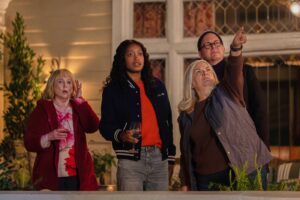
Keke Palmer is a fish out of water in horror-comedy series based on cult movie ‘The ’Burbs’
By Canadian Press on February 6, 2026.
NEW YORK (AP) — The suburbs are anything but bland in the new Peacock series “The ‘Burbs,” where strange things are going on. Like how jokes mix with the dread.
Inspired by the 1989
Tom Hanks-led movie of the same name, “The ‘Burbs” follows a new mom as she navigates a foreign world of white picket fences and manicured lawns while also investigating a possible murder.
“It’s got the comedy, it has the drama, it’s got the mystery, it’s got the horror, the thrills, the suspense — all of it,” says Celeste Hughey, the creator, writer and executive producer. All eight episodes drop Friday.
Hanks is replaced by
Keke Palmer, who plays a newlywed and new mom who moves into her husband’s family home in fictional Hinkley Hills, where everyone is in everybody else’s business. “Suburbia is a spectator sport,” she is told.
Across the street is an abandoned home, where a local teen disappeared decades ago. Palmer’s Samira soon joins forces with a band of off-beat suburbanites to help solve the case, even if her own husband had some sort of role.
“I really wanted to focus on that fish-out-of-water feeling, centering Samira as a Black woman in a white suburb who is a new mom, a new wife — new everything — and trying to figure out where she belongs in the environment,” says Hughey.
Jokes and social commentary
The cast includes Jack Whitehall as Samira’s husband and the trio of Julia Duffy, Mark Proksch and Paula Pell as her wine-swilling, investigating neighbors who form a sort of found family.
“The movie came out when I was quite young, but I remember seeing it as a kid and it being like this terrifying movie to me,” says Hughey. “But revisiting it as an adult, it’s just like the most timely movie.”
The scripts crackle with witty humor, from references to Marie Kondo to
“Baby Reindeer,” and jokes often improvised by the actors. Chocolate brownies are described as “the Beyoncé of desserts” and there’s a joke about how white ladies love salad.
“The ’Burbs” also touches on more serious issues over its eight episodes — microaggressions, racial profiling, bullying and childhood trauma — but takes a kooky, off-beat approach.
“I always look at things with a sense of humor,” says Hughey. “I think comedy is a way to be able to examine all these pretty heavy subjects, but in a way that’s accessible, in a way that is clarifying.”
Palmer says she grew up watching
Norman Lear shows and admired his ability to both entertain and address social tensions — something she found in “The ‘Burbs.”
“When I read this script for the first time, then as we started doing the show, it started to become clear that we had an opportunity to do the same thing,” Palmer says. “We can expose cliches, we can lean into things, which is one of the greatest tools of satire and comedy in itself, and horror as well, because horror can play as a good allegory for the issues in our life.”
‘Play in both genres’
Whitehall, who grew up in the London suburb of Putney, says he appreciates that the social commentary never feels that heavy handed between the comedy and horror: “It was great to sort of be able to play in both genres.”
There are multiple nods to the original movie, like picking the last name Fisher after
the late actor Carrie Fisher, who appeared in the Hanks-led version, and naming a dog Darla after the name of the pup who starred in the 1989 version. Hanks, himself, appears in a blink-or-you’ll-miss-it image.
There’s a scene where Samira steps onto her neighbor’s grass and leaves suddenly swirl around her feet menacingly, an echo to the original. And there’s a moment when sardines and pretzels are served, a riff off a classic moment in the movie. The creators even asked original actor Wendy Schaal to return to play the town librarian.
“I really wanted to honor the original fans of the movie and make sure that they see that someone who respects the original material and loves the movie had it in their hands,” says Hughey. “I see the fans.”
Hughey said she wrote the series with Palmer’s voice in mind, a piece of manifesting that turned out to actually work when she first met Palmer over a year later.
The music ranges from
Bill Withers’ “Lovely Day” to Steve Lacy’s “Dark Red” to Doechii’s “Anxiety” and Big Pun’s “I’m Not a Player.”
“Music is very much a part of my creative process and something that I wanted to stand out in the show as well,” says Hughey. “I got to pull in so many of my inspiration songs.”
Mark Kennedy, The Associated Press
26
-25