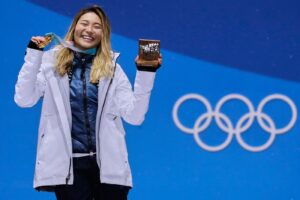
Chloe Kim rediscovers love for Olympics. Will an injury derail quest for a 3rd straight gold medal?
By Canadian Press on January 23, 2026.
COPPER MOUNTAIN, Colo. (AP) — Chloe Kim’s third run to the Olympics started with the usual questions: How will she handle the pressure? Can she enjoy the journey? How does being famous elevate or diminish the experience? And, of course, will she win her third straight gold medal?
Now, comes one that nobody saw coming: Will America’s best snowboarder, one of the major attractions of
next month’s Milan Cortina Games, even make it to the halfpipe? If she does, will she be anywhere near 100%?
A
shoulder injury during training has turned the buildup to the Olympics into a scramble for the 25-year-old Kim, whose catalog of tricks outclasses everything else in this high-risk, high-reward sport.
“Obviously, I’m really disappointed that I can’t snowboard until right before the Olympics, which is going to be hard,” Kim said in
a recent update on Jan. 13, four weeks before the start of the women’s halfpipe contest. “I haven’t gotten nearly the amount of reps that I would have liked, but that’s OK.”
The question of Kim’s health will hover over the one of the marquee contests of the Olymipcs and over the result itself.
If she wins, it will mark another stunning accomplishment for the California kid who
took over the halfpipe 10 years ago — a smiling 15-year old who loved the mall, her dog Reese and the first day of any month because that’s when her mom paid out her allowance.
If she doesn’t — and someone like Gaon Choi of Korea or Sena Tomita of Japan wins — well, that might be chalked up to the best snowboarder not being at full strength.
“To some level, I think (the shoulder) is something that will be in her mind if she does decide to compete,” said Shaun White, the three-time gold medalist who dealt with big injuries in the lead-up to his last two Games. “But, also, she’s in a league of her own trick-wise.”
Kim knows the Olympics are the gold standard of her sport
For everything she has accomplished — the record eight Winter X Games golds, the three world championship titles and the tricks she does that nobody else even attempts — the Olympic gold medal is the benchmark in this sport. For Kim, gearing up to take her game up another notch every four years makes the mental gymnastics almost as difficult as the physical ones.
It’s a reality that a few years ago forced her to restart her search for joy in a sport that, over time, has turned into something different than fun and games.
“When you have the level of fame that she has reached, it gets to be a lot more like a job,” said her longtime coach, Rick Bower. “Some of that love you had when you were younger gets lost a little bit. One of the biggest things she’s worked on over the last few years is just finding that spark of why she actually does this.”
Scattered among her dozens of social-media posts that show her peddling products, heading to the gym, talking about her driving acumen and making matcha was a revealing take on why she keeps going out there.
“I feel like I love the adrenaline and the pressure I feel when I am snowboarding,” she said. “I find it very rewarding, too. There’s nothing that can compete with the feeling of accomplishing something you once thought was impossible, and pushing yourself and being able to see the result of all your hard work.”
Her career is full of those moments.
Last January, Kim became the first woman to land a double-cork 1080 in a competition (that’s two head-over-heels flips while spinning 360 degrees).
She is approaching the 10th anniversary of the date when she became the first woman to do back-to-back 1080s, three spins in one jump above the pipe.
In 2024, during a victory lap at the Winter X Games, she added a half spin to her 1080 and became the first woman to pull off a 1260.
She had tried, and failed, to pull off a 1260 at the 2022 Olympics in China. In a world that only Kim and a few others can understand, that had no impact on her winning the gold medal — she did that easily with her second-best run — but made all the difference in how she viewed the day.
“It’s unfair to be expected to be perfect,” she said that day, “and I’m not perfect in every way.”
More than the gold medal, Kim said, she found her joy in the quest for progression, the favorite word of any great snowboarder. Nobody has progressed women’s snowboarding more than she has over the past decade.
“You’re going to see someone designing a whole new run that’s never been done before,” said Kelly Clark, the 2002 Olympic gold medalist who befriended Kim when she was starting out. “There’s a creativity and individual expression that makes it so cool.”
Risks on the halfpipe are mental as much as physical
Creativity and progression come with risks. The best, after all, are supposed to win. By not playing it safe, Kim puts that in jeopardy. Clark, who has Olympic gold and two bronze, is among the rare few who can relate to what the current Olympic champion is feeling.
“I didn’t find it very sustainable when you did things for external purposes,” she said. “If you did things just because it was an Olympic year, I usually found that involved a lot more pressure.”
If these musings sound familiar — about Kim struggling with fame, struggling to rekindle her love of snowboarding, struggling with it all — they are. In 2018, about a month after winning her first gold, she conceded fame was different from what she imagined.
It included everything from paparazzi following her, to fans watching her eat in restaurants to an ugly spate of anti-Asian trolling that has been a steady, disturbing through-line over the career of a California native whose parents are Korean.
Heading into 2022, Kim opened up about her own mental-health challenges, especially in the furor of the pandemic. The disease originated in China, which led to a backlash against people of Asian heritage.
“I experience hate on a daily basis,” Kim wrote in a 2021 essay published on ESPN.
Her feelings heading into these Olympics might have been summed up best in one of her rare interviews: “I just want to go back to loving it again,” she told Harper’s Bazaar last summer.
Next up, Kim goes for history and three straight gold medals
Now, the question is: Does she have to win to love it? Also, what will it take to win, especially with the calculus changed because of the injury?
Bower believes Choi and Tomita have tricks that will prompt Kim to bring more than her “B” game to win.
As Italy approaches, that’s what pressure feels like for an adrenaline junkie who likes to create art on the mountain.
“She goes to an event, she’s expected to win,” Bower said. “That’s a very overwhelming proposition for anybody. But she’s done a very good job of focusing on what makes her excited to strap on a snowboard.”
___
AP Winter Olympics:
https://apnews.com/hub/milan-cortina-2026-winter-olympics
Eddie Pells, The Associated Press
41
-40