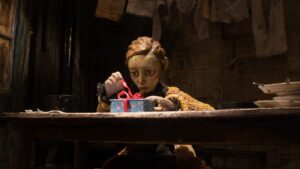
Chris Lavis and Maciek Szczerbowski say it’s a “weird emotional honour” to represent Montreal at the Oscars.
Their stop-motion fable “The Girl Who Cried Pearls” earned a nomination Thursday for best animated short film.
It’s the second time the longtime duo has been recognized in the category — their debut short “Madame Tutli-Putli” got a nod in 2007.
“That was 18 years ago. We were young men. We did not have children. We didn’t care about making our mortgage like we do now,” says Lavis on a video call.
“We had zero career, and now I guess we have something like a career.”
“We weren’t ugly yet,” jests Szczerbowski.
The haunting tale about an impoverished boy who falls in love with a girl who weeps pearls at night is set in Montreal at the dawn of the 20th century.
The duo say they wanted give Montreal its own mythology, akin to those that define cities around the world.
“We felt a responsibility to make our daughters grow up in a city that they can feel is mysterious and fantastical and to give as much of that kind of mythology to the streets we walk and they grow up in,” says Szczerbowski.
Like their debut, “The Girl Who Cried Pearls” was funded by the National Film Board of Canada, which Lavis says means they’re representing “Canadian cultural capital” at the Oscars.
Szczerbowski adds it’s a particularly special moment for Montreal, as several of the city’s creatives worked on the film.
Art director Brigitte Henry helped build its miniature sets, while composer Patrick Watson worked on the score with help from local musicians including Arcade Fire’s Richard Reed Parryand Godspeed You! Black Emperor’s Sophie Trudeau.
“These are magnum talents. I don’t even know how to put into words our gratitude for them repeatedly collaborating with us and trusting us. I’m going to tear up,” says Szczerbowski, getting visibly emotional.
“These are all our friends and neighbours, people we go have beers with, people whose children our children are friends with. It’s an amazing thing for our tiny little community.
“The city of Montreal is still a city of artists, and it is lousy with talent.”
Also nominated is Montreal’s Alison McAlpine, who is up for best documentary short with “Perfectly a Strangeness,” an experimental film streaming on Crave that captures three donkeys discovering an astronomical observatory in the Atacama Desert.
“We jumped high when we heard the news because it was unexpected,” says McAlpine.
“I don’t think my film is strange, but it’s not journalistic American-style, which most of the films in the Oscars are, which is fine. It’s just not my esthetic. So, we weren’t sure… It’s an out-of-the-box film and it was an amazing surprise.”
They aren’t the only Canadians getting Oscars love this year.
“KPop Demon Hunters,” written and co-directed by Toronto’s Maggie Kang, was nominated for best animated feature.
The smash hit, which is the most-viewed film in Netflix’s history, also earned a nod for best original song for “Golden,” which in August hit No. 1 on the Billboard Hot 100.
Also competing in the best animated feature category is “Elio,” co-written and co-directed by Domee Shi of Toronto.
The Canadian teams behind the look of “Frankenstein” were nominated for makeup and hairstyling — Mike Hill, Jordan Samuel and Cliona Furey. The production design team on the film also received a nomination, including production designer Tamara Deverell and set decorator Shane Vieau.
The Guillermo del Toro Netflix film is also up for best picture, landing Canadian producer J. Miles Dale on the list of nominees.
Lavis and Szczerbowski say the Oscars recognition disproves the long-held notion that Canadian creatives need to leave the country to get noticed.
“Some wisdom goes that you don’t move to where it’s happening, you make it happen where you live,” says Szczerbowski
“In moments like this, you feel like that’s succeeded.”
This report by The Canadian Press was first published Jan. 22, 2026.
-With files by Nicole Thompson in Toronto and Sébastien Auger in Montreal
Alex Nino Gheciu, The Canadian Press