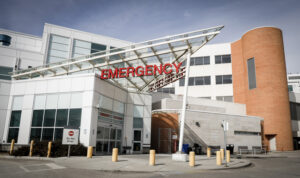
The emergency department of the Rockyview General Hospital is pictured in Calgary on March 20, 2025.--CP FILE PHOTO
zmason@medicinehatnews.com
Doctors have shared a list of anonymized cases with hospital leadership that illustrate a system at its limits as crisis conditions continue in Alberta’s ERs.
The News obtained the document from an anonymous source. The document contains details regarding six deaths described as preventable and more than 30 “near misses,” many of which produced suboptimal outcomes. All the cases featured in the document occurred since the Dec. 22 death of Prashant Sreekumar at Grey Nuns Hospital in Edmonton.
Dr. Paul Parks, a Medicine Hat physician and the president-elect of the Alberta Medical Association section of emergency medicine, compiled the document and shared it internally with the province’s senior health leadership, including Premier Danielle Smith and Minister of Hospital and Surgical Health Services Matt Jones.
The file was subsequently shared with the press by an anonymous source. While it wasn’t Parks who publicized the document, he says he is in full agreement with the reasons for its release.
He says he circulated the document on Jan. 11. He has yet to receive a response from government.
The anonymized cases were submitted to Parks by doctors from across the province.
One of the deaths outlined in the document describes a female patient who waited for eight hours overnight to be seen in an emergency room with a bowel obstruction. By the time the patient was seen, she was septic, and although she received emergency surgery, she succumbed to her illness about 24 hours later in the ICU.
Another case involved a middle-aged man who presented to an Alberta ER with chest pain. Despite the patient’s concerned family approaching the desk multiple times, it was approximately eight hours before a bed became available for the patient. Shortly after entering the room, the patient suffered an arrest that the document describes as a likely pulmonary embolism or dissection. He could not be saved.
In the document, Parks highlights the troubling similarities between this case and the death of Sreekumar in Edmonton.
Part of the impetus for putting the document together in the first place, says Parks, was the shared belief among emergency physicians and general internal specialists that the death of Sreekumar could easily have occurred at any number of overwhelmed emergency departments across Alberta.
“Our hallways and waiting rooms have become death zones, and we wonder how many ‘ticking time bombs’ will drop dead when they should be receiving life-saving care in a functional emergency care space,” wrote Parks.
The second half of the document consists of a list of more than 30 cases where Parks argues that high-stakes diagnoses were delayed and patients were treated in substandard conditions.
Examples include patients examined while standing up in crowded ERs, resuscitations taking place in hallways and bad news being delivered to families in public spaces.
Parks says several cases in which patients required ICU admission could have been avoided if more timely interventions had occurred upon arrival at the emergency department.
Dr. Raj Sherman, former Associate Minister of Health and a practising emergency physician in the Edmonton area, shares the perspective of Parks and others that the system is in crisis.
“The ER is a canary in the coal mine,” said Sherman. “The canary is dead.
“When every ER bed is plugged up by admitted patients, the health system is collapsing.”
In a statement to the News on Tuesday, press secretary for the Ministry of Hospital and Surgical Health Services Kyle Warner says the ministry is unable to comment on the information circulated in the media due to privacy and legal considerations.
Warner says Minister Jones has reached out to the AMA to convene a meeting with Acute Care Alberta and the AMA to discuss solutions to the present acute care pressures.
“He wants to ensure a shared understanding that the system is under exceptional strain,” said Warner.
Doctors: Crisis on horizon for years
Parks says physicians found the government’s early dismissal of their calls for a state of emergency shocking.
“We were initially met by a government response that was truly gaslighting, actually saying that our concerns are misguided and downplaying it,” said Parks.
Provincial hospital leadership held a press conference Jan. 15. While the preventable deaths document was not broached, Jones took accountability for what he described as “extreme pressure” in the health-care system.
Jones held another press conference Tuesday to announce the completion of an expansion at the Peter Lougheed Centre in Calgary that adds 97 beds to that facility, including 28 in the emergency department.
Responding to a question about the preventable deaths document, Jones said that while he takes the concerns brought forward by the case list document seriously, he doesn’t believe they paint an accurate picture of the state of operations.
“I don’t feel that these anonymized cases are representative of the incredible care that our system and our frontline medical professionals provide on a day-to-day basis,” he said.
Parks says he’s in complete agreement with the minister about the quality of care in Alberta, which he describes as world class.
“Getting access is the issue on all fronts, and that’s what we’re pleading with government about. The reason that document was created was we want government to share our sense of urgency,” said Parks.
Jones’s Tuesday press conference included an overview of the major long-term investments into hospital capacity the government is making. Parks says those investments are too little, too late.
A widening chasm between the province’s growing population and its acute-care capacity has taken shape over the last several decades.
In 1992, 2.7 million Albertans were served by 11,700 staffed hospital beds. Today 5 million people reside in Alberta, and the number of acute-care spaces has dropped to just under 8,800.
Jones confirmed Tuesday that as many as 1,300 beds are occupied by alternative level of care patients on any given day. That leaves the province with 1.5 acute-care spaces per 1,000 people, a staggering decrease from the 1992 figure of 4.3 beds per 1,000.
Parks says a major new hospital project has not been completed since 1988. In March 2024, the UCP government pulled the plug on a South Edmonton hospital project committed to by the NDP government in 2017. Construction on that project was scheduled to be complete by 2026.
“There’s no possible way the Edmonton zone can serve a 2026 population with a bed base that’s from 1988,” said Parks.