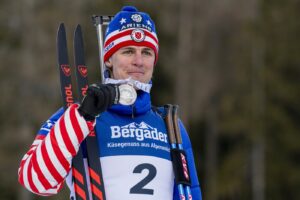
Fun-loving Kiwi Campbell Wright gives the US hope for its first biathlon Olympic medal
By Canadian Press on January 17, 2026.
The U.S. has never won an Olympic medal in
biathlon, the only winter sport where that’s the case.
The drought could come to an end next month at the
Winter Olympics.
The team brought on Campbell Wright, a rising star and dual citizen from New Zealand who combined fast skiing and precision shooting to win two world championship silver medals last year and has had strong results this season.
In addition, the team has a homecourt advantage, of sorts: Their Italian head coach, Armin Auchentaller, grew up in Antholz, the village that’s hosting the Olympic biathlon competitions. His assistant coach and support staff are also from the region, ensuring the team has the inside scoop on the ski trails, snow, climate, food and housing.
“We feel Antholz is almost a second home to us,” said U.S. Biathlon CEO Jack Gierhart. “Armin made it easy for us to operate there. That will enable our athletes to focus and feel relatively relaxed, which is really important in this level of competition.”
Winning athlete and coach
Wright said he trusts his fitness and training as he heads to the Games, where the pressure will be on him to perform.
“I think having success in the past just gives me confidence because I’ve already done more than I thought I could do in this sport, so the way I see it anything extra is just cream,” he told The Associated Press.
Auchentaller said working with Wright has been one of the most rewarding experiences of his career.
“From the very start, you could tell he had something special — not just raw talent, but that spark of joy when he moved, competed, trained. That early talent was obvious,” Auchentaller said. “But what made working with him truly remarkable was how quickly he combined that talent with professionalism.”
Wright will be joined by Olympic newbie Maxime Germain and Paul Schommer, who is competing in his second Games, while Sean Doherty will race in his fourth. On the women’s side,
Joanne Reid returns to competition after two years off and heads to her third Olympics. Teammate Deedra Irwin returns for her second and two new members, Margie Freed and Lucinda Anderson, will make their Olympic debut.
Who is Campbell Wright?
Wright, a 23-year-old from Wanaka, New Zealand, was born and raised Down Under by American parents who emigrated there in the 1990s. He spent his early years at the Snow Farm cross-country ski center, learned biathlon in Europe and raced for New Zealand at the Beijing Olympics. Seeking support from a seasoned team, his dual citizenship allowed him to join the U.S. in 2023.
That support has helped him to thrive.
In February 2025, he became the first U.S. biathlete to win two medals at one world championship event, taking home back-to-back silvers in the sprint and pursuit competitions in Lenzerheide, Switzerland. They were the first U.S. world medals since Susan Dunklee won silver in 2020. She also won silver and Lowell Bailey gold in 2017.
Auchentaller said he was proud but not surprised by Wright’s performance.
“I knew that beneath his talent lay a core of grit, a fearless heart, and a grounded, simple work ethic,” Auchentaller said. “His success didn’t feel like luck or a one-off; it felt like the natural outcome of years of hard, intelligent work, fueled by genuine love for what he does. Watching him step onto that podium, I saw a young man’s passion and dedication pay off — and I felt fortunate to have witnessed his growth from early promise to world-class performer.”
Keeping it fun
Wright’s Kiwi accent and light-hearted nature has endeared him to fans around the world. He often smiles and waves at adoring supporters who call his name from the stands, looking like his having the time of his life.
Wright’s multiple top-10 finishes on the World Cup circuit last season secured him the the U23 Globe for the best athlete 23 years old or younger, another first for a U.S. biathlete. He said his youth helps makes racing less stressful.
“I’m hopefully at the start of a long career and I think that also helps take the pressure off,” he said. “If this season goes poorly, there are a lot more years for me to try again.”
Training plan that works
Early in the World Cup season, Wright made his presence known by skiing to the front of the pack and consistently shooting well even in high-stress head-to-head battles. He said his training plan worked for him last season, so he has no intention of changing things, even though it’s an Olympic year.
“I think it’s a good one,” he said. “I think a lot of athletes tie themselves in knots trying to reinvent the wheel, but what we do isn’t complicated, it’s just hard.”
Auchentaller said what makes Wright special as a biathlete goes beyond a single skill. He has speed, focus, a positive attitude, sure, “but the real difference lies in his simplicity.” He doesn’t overthink things and maintains a calm confidence even when things don’t go as planned, which is inevitable in biathlon.
Suddenly the wind changes direction, you miss the first two shots, you drop your sunglasses, someone crashes in front of you, you drop a magazine. Every race has the potential for mishaps.
“Instead of panicking or doubting himself, he stays grounded, believes in the work he’s done, and keeps moving forward,” Auchentaller said. “That trust, combined with his simplicity and adaptability, is what makes him truly stand out in the sport.”
If Wright can keep it up, it could fulfill a dream that has eluded the U.S. for decades.
___
AP Winter Olympics:
https://apnews.com/hub/milan-cortina-2026-winter-olympics
Martha Bellisle, The Associated Press
34
-33