TORONTO — Ontario politicians and Canada’s largest private sector union are slamming Canada’s new trade agreement with China, saying it puts domestic auto jobs at risk with no guarantee of investments.
Prime Minister Mark Carney announced Friday that Canada has agreed to slash its 100 per cent tariff on Chinese EVs for up to 49,000 vehicles per year.
In exchange, China will drop or significantly reduce its retaliatory tariffs on Canadian agriculture products, including canola seed and meal, pork, seafood and peas.
Carney has framed the deal as a new strategic partnership with China that presents enormous opportunities for Canada.
“It’s a partnership that reflects the world as it is today, with an engagement that is realistic, respectful and interest-based,” Carney said at a news conference in Beijing.
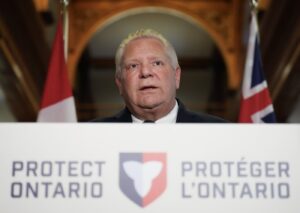
But Ontario Premier Doug Ford and Unifor national president Lana Payne say it’s giving unfairly subsidized Chinese automakers a foothold in Canada that puts the Canadian industry at risk.
“This is going to be terrible, for not only just all the people of Ontario, but especially the auto manufacturers, the supply chain,” said Ford during a media scrum Friday.
He called the deal lopsided and warned it risks closing the door to the U.S. market for Canadian automakers, while also raising concerns about the security risks the cars pose.
“It’s just a terrible, terrible, miscalculated decision by the Prime Minister.”
The deal rewards labour violations and unfair trade practices, said Unifor’s Payne in a news release.
“This is a self-inflicted wound to an already injured Canadian auto industry,” she said.
“Finding a resolution to U.S. auto tariffs just got more difficult.”
The federal government has noted that along with benefits to other sectors seeing reduced tariffs, the deal for 49,000 vehicles at a lower 6.1 per cent tariff represents less than three per cent of the Canadian market for new vehicle sales. It’s also the same volume of EVs that came in from China in 2023-2024 before Canada followed the U.S. in hiking tariffs to protect domestic producers.
The government also said that it expects within three years for the deal to drive “considerable” Chinese joint-venture investment in Canada to create new auto manufacturing jobs, but both Ford and Ontario NDP Leader Marit Stiles blasted the lack of firm commitments.
“Let me be clear: Mark Carney is selling out our auto sector,” said Stiles in a social media post. “Our workers deserve guarantees – you don’t protect an industry with maybes.”
But with little to no Chinese EV presence in Canada, it’s hard to imagine the government could have secured a production guarantee, said Greig Mordue, associate professor at McMaster University’s W Booth School of Engineering.
“It’s a smart policy. Doesn’t give us a Chinese auto plant, but I don’t think anything would. So this is fine,” said Mordue, who previously was general manager of Toyota’s Canadian division.
He said the quota system was also how the federal government approached the rising threat of Japanese producers Toyota and Honda in the early 1980s, while a few years later the government used their established sales as leverage to push them to built plants in Canada.
He said the limited quota might not even be enough to incentivize Chinese brands to enter the Canadian market, but could see more China-produced Teslas, Polestars and Volkswagens come in. Either way, it’s not enough to affect domestic automakers, he said.
“This has virtually no impact on Canadian production.”
Longer-term, there could be cheaper options though. The Canadian government said “it is anticipated” that in five years, 50 per cent of the Chinese EVs coming in will have an import price of less than $35,000. The quota of low-tariff vehicles is also set to rise to 70,000 by then.
Ford said that while the deal has small volumes now, it gives China a foothold into the Canadian market that it will use to its full advantage at the expense of Canadian workers.
“They start off with always saying three per cent. Ask people in Brazil what happens to three per cent; turns into 37 per cent. Ask the people over in Europe.”
The EU saw Chinese-built electric cars jump from 3.9 per cent of its EV market in 2020 to 25 per cent by September 2023, prompting the block to impose a range of tariffs up to 35.3 per cent as it alleged unfair trade practices. Though it has started to move instead towards minimum prices for Chinese EVs.
The block has said companies in China accomplished the market gains with the help of subsidies all along the chain of production, from cheap land for factories from local governments to below-market supplies of lithium and batteries from state-owned enterprises to tax breaks and below-interest financing from state-controlled banks.
Ford said the Chinese-made cars not only raise security concerns but are being produced at artificially low costs.
“They’re heavily subsidized, totally against all the autoworkers here in Ontario,” he said.
“This is not a good situation for the auto sector as a whole.”
This report by The Canadian Press was first published Jan. 16, 2026.
— With files from Allison Jones in Toronto and The Associated Press.
Ian Bickis and Sarah Ritchie, The Canadian Press