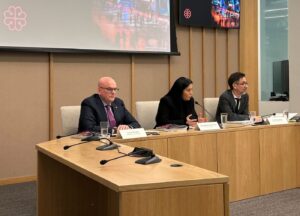
MONTREAL — Montreal Mayor Soraya Martinez Ferrada tabled her first city budget since winning November’s election, unveiling $7.7 billion in spending for 2026, including new money for homelessness and housing.
“We made sure that every dollar invested serves the interests of all Montrealers. It sends a clear message, of re-centering the services of the city on the needs of Montrealers,” Martinez Ferrada told reporters at city hall on Monday.
Her administration’s first budget raises spending by about 5.4 per cent, with last year’s budget coming in at $7.3 billion. Provincial law prevents municipalities from running operational deficits.
The budget includes average property tax increases of 3.8 per cent for residential properties — a figure that includes borough taxes — and 3.4 per cent for non-residential buildings.
During a news conference at city hall, the mayor emphasized that the budget is an example in fiscal restraint, “the city’s credit card was maxed out,” she said, calling the new plan both rigorous and responsible.
The property tax increase, Martinez Ferrada said, is a “first step,” she said, “to make it more efficient, a task that will continue throughout the term of office, in order to slow the growth of spending.”
Total debt service in 2026 is projected to be 16.6 per of expenses. The city’s consolidated net debt in 2026 will be roughly $7.3 billion excluding the $1.3 billion in net debt of the public transit system.
Chief among the city’s priorities, the mayor said, is tackling the homelessness crisis. Martinez Ferrada announced that funding for community organizations serving unhoused people will triple next year, rising from $9.8 million to $29.9 million. “We made a very clear choice to make the fight against homelessness a priority,” she said.
The city announced $100 million to buy and convert buildings into emergency shelters between now and 2035. The mayor noted her team had already increased the number of beds available during the early weeks of her mandate by 500. “Winter came early, we didn’t want to wait, lives needed to be saved.”
While expanding shelter space is critical, Martinez Ferrada argued that prevention is just as important. “Getting people off the streets is a priority, but first and foremost, we need to prevent them from getting there in the first place,” she said.
Martinez Ferrada announced the city plans to invest $579 million over 10 years to acquire “strategic buildings” and convert them into housing. The city aims to create 75,000 homes by 2050.
Additional funds are earmarked for public safety, including protective equipment for firefighters and new technology for police. The city will invest $67.5 million to replace firefighters’ protective clothing, and $185 million to replace the city’s fire trucks. Another $40 million will be invested over the next decade to equip patrol officers with body cameras.
Martinez Ferrada also announced $17.4 million to make areas around schools safer.
The mayor also positioned downtown Montreal revitalization as an economic priority, arguing the area must remain a cultural and commercial anchor. Her administration plans to continue funding for festivals and cultural programming, while boosting the budget of the Conseil des Arts de Montréal by $2.5 million, bringing the total budget to $24.4 million for 2026.
To help cover the new spending, the city said it found $79 million in savings, largely through a review of municipal programs. The city also said it has frozen hiring in parts of the public service.
This report by The Canadian Press was first published Jan. 12, 2026.
The Canadian Press