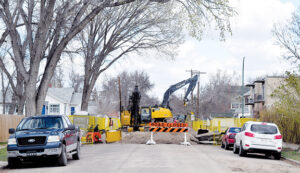
Work to replace underground sewer and water mains in Medicine Hat has been ongoing since 2014, such as this work on Fifth Avenue SE in 2019, part of why the city says disasters like that in Calgary are of no concern here.--NEWS FILE PHOTO
zmason@medicinehatnews.com
The City of Medicine Hat is paying close attention to the situation unfolding in Calgary, where for the second time in two years the city of 1.6 million is under water-use advisories after a water main break.
While there are plenty of lessons to take away from what’s happened in Calgary, City of Medicine Hat associate director of environmental utilities Kim Dalton says there’s little worry that something similar will happen here.
“Calgary is a very unique situation, because of where the infrastructure is,” he told the News on Thursday. “It’s a cascading series of events.”
Dalton says the water main that ruptured Dec. 30 was damaged by erosion caused by decades of heavy salt use on the nearby Trans-Canada Highway, a factor that does not impact Medicine Hat’s critical water infrastructure.
Other factors also contribute to failures like that one, including climate and soil composition. Areas that experience a lot of thaw and frost are facing higher risk, as are areas with heavier clay in the soil, which retains more water. Factors like these are routinely monitored and accounted for during the city’s regular infrastructural maintenance.
The same Calgary main failed less than two years earlier in June 2024. In an independent report released Wednesday, investigators noted that the risk of a failure in the main was first identified in 2004, following a similar rupture on the same type of pipe in northeast Calgary.
While the city has been carrying out a large-scale infrastructure renewal plan since 2014, Dalton says crisis points like the one in Calgary motivate officials in other municipalities to try new approaches to maintenance and monitoring.
“When they go through what they went through in 2024, new technologies and new methods arise from that, and the rest of the province and the rest of the industry is going to benefit from that.”
He says Medicine Hat is currently undertaking a review of its own critical infrastructure that uses the power of artificial intelligence.
The city also contacted the manufacturer responsible for the ruptured line in Calgary, which also supplied infrastructure to Medicine Hat decades ago, to ensure the Gas City is not vulnerable to the same type of failure. It isn’t.
Failures like the one in Calgary also increase the public’s understanding of and appetite for infrastructure replacements and renewals.
According to Wednesday’s report, despite repeated identification of the risk of failure in the affected water main, the City of Calgary prioritized other critical needs and deferred inspection, monitoring and risk mitigation on the main.
It attributes this deferral to a failure to appreciate the likelihood or significance of a failure, and a pattern of systemic gaps in the Water Utility’s approach to managing critical infrastructure.
“The City of Calgary, they knew that line out to Bearspaw was a very critical asset, and it had high chances of failure. When they went to city council, they could only come up with 70 million, not the full scope of the project,” said Dalton.
Dalton says large infrastructure projects are brought before council and funded on a case-by-case basis. In Medicine Hat, council has supported the city’s ambitious renewal plan, which began in 2014.
The plan comes with a hefty price tag of $900 million over 30 years. Council also allotted $6.3 million for a major water main replacement that Dalton says will commence in Q3 of this year, with a target completion date in early 2027.
“That’s for a main feeder that goes to Kipling, so that’s the booster that’s by the skate park. That booster supplies a third of the city’s water, all the way up to the college and the Cottonwood area. If that ever went down, we would have major issues throughout the city,” he said.
This year’s major project will add a second line, adding resiliency to a crucial part of the system that would act as a failsafe in case of a failure like the one in Calgary.
Although these projects are expensive, Dalton says the city explores every available option to reduce costs for the taxpayer. He says the city is exploring the possibility of using an abandoned line to host the new pipe for the Kipling line, which is currently in the engineering phase.
The old pipe would be renewed with a liner without disturbing the top surface, a process Dalton says would be a fraction of the cost of installing new infrastructure.