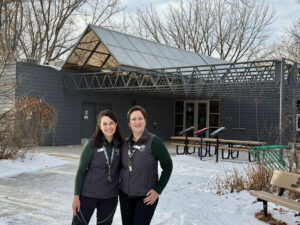
Park interpreters Alicia Voth and Mhairi Donnelly pose outside the Nature Centre in Police Point Park on a winter's day.--News Photo Anna Smith
asmith@medicinehatnews.com
Facing the new year and a 40th anniversary, the Medicine Hat Interpretive Program also reflects on its past and present.
The program first began in 1982, which is also when the Nature Centre located in Police Point Park was first opened. While it is a long time partnership between the City of Medicine Hat and the Society of Grasslands Naturalists, said chief park interpreter Alicia Voth, the program’s staff are officially employed by the society, which is a registered charity.
What they do with that charity, which means MHIP runs primarily off of grants and donations, is education.
“Our main thing that we do is education. Primarily with elementary schools, but also some kindergartens and home school groups,” said assistant chief park interpreter Mhairi Donnelly. “We also offer programs for the community, for visitors to either the city or even Alberta and Canada, as well as just things that local people can participate in.”
With the exception of some craft-oriented programs, a majority of the public offerings are completely free to attend. These programs also take them beyond Police Point Park, where they are based to the greater city and beyond, such as Brooks, Irvine or nearby colonies as they are approached by teachers or interested groups.
“We’re very mobile. We go to schools sometimes, if schools can’t come to us. The nature centre display here in the centre also changes several times a year. So part of our job is to provide education through that space as well,” said Voth.
Currently, MHIP is a team of five wearing multiple hats as they come up with and deliver programming, walk the trails to connect with park visitors and often answer various nature-related questions from the public throughout the day.
In an average year, Voth estimates that they deliver more than 100 school programs and roughly 100 public programs as well.
“It’s all about trying to enthuse people about our local environment and the plants and animals that exist here, and why there are the relationships that do exist within the ecosystem,” said Donnelly. “So it’s trying to connect people, because if you can make that connection with your landscape, then it should naturally follow that you want to be a steward of it.”
While MHIP for many is a point of connection to people and nature, staff stress that they do not do wildlife rehabilitation.
While they can direct residents to the correct channels, the Nature Centre does not have the facilities or the training to take care of injured, ill or abandoned animals.
They are first and foremost educators, said Voth, who try to incorporate storytelling and hands-on experiences into their various learning opportunities.
“There’s an old Chinese saying: I hear, I forget, I see, I remember, I do, I understand. So for us, in many of our programs, whether it’s school or the public, there’s always talking, but we try to get people outdoors, to actually see the things that we’re talking about,” said Donnelly. She says this helps them make personal connections to the subject and to nature as a whole.
Programs come from a variety of sources, from public popularity to the interpreter’s personal interests or information they feel the public needs to be more aware of, but all of them are focused on creating connections between people and the outdoors.
Looking back on 40 years, Voth says they look forward to seeing everything the year has to offer and invite the public to come down to the Nature Centre and Police Point Park, to be part of the ecosystem and to support what they continue to do right here in Medicine Hat.