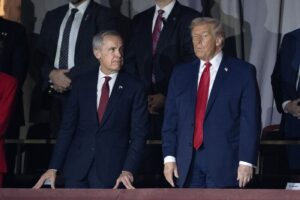
OTTAWA — U.S. President Donald Trump’s tariff campaign against Canada — and the surge in patriotic zeal it inspired — have been voted The Canadian Press News Story of the Year.
Nearly two-thirds of editors and news directors surveyed from media organizations across the country picked the political and economic upheaval caused by Trump’s trade war as the most consequential story of 2025.
The Toronto Blue Jays’ momentous World Series run came in second place, followed by the spring federal election.
The tariff dispute’s far-reaching impact on Canadian politics, economy and national identity meant it dominated headlines throughout the year.
“There isn’t a single Canadian, I believe, who hasn’t felt the impact of the tariff war. It is the dominant story of 2025,” said Dan Charuk, an editor at Metroland Media Group in Hamilton, Ont.
Cracks between Canada and its largest trading partner started to spread following Trump’s re-election in late 2024. He promised during the election campaign to use tariffs to pay for his divisive agenda and rectify what he saw as the unfair treatment of the United States on a global scale.
The schism widened ahead of his inauguration in January as Trump continually called for Canada to become the “cherished 51st state.”
Trump delivered on his sweeping tariff threats in the ensuing months — but his ever-shifting deadlines often spread confusion over which products would be taxed, which would be exempt and when the tariffs would come into effect.
He fixed the Canadian and Mexican automotive, steel and aluminum industries in his crosshairs before imposing tariffs on China and other countries in April — the so-called “Liberation Day” tariffs — as part of his bid to reshape the global system of trade.
The combative president’s return also transformed politics in Canada.
After former prime minister Justin Trudeau announced his resignation at the start of the year, former central banker Mark Carney handily secured the Liberal party leadership as he positioned himself as the best person to lead the nation through an unprecedented crisis.
Carney would use that momentum to carry the Liberals to a fourth straight electoral victory in April, defeating Pierre Poilievre’s Conservatives, who were widely seen as the government-in-waiting in late 2024.
In early April, Carney gave Canadians a stark assessment of Trump’s protectionist policies. The old era of deepening integration between Canada and the United States was over, he declared, calling for a new path forward that does not rely on U.S. market access.
But as tariffs were reshaping Canadian politics and threatening to upend the economy, another force was rumbling beneath the surface.
The response to Trump’s trade aggression and “51st state” talk was a surge in Canadian pride.
Polling throughout 2025 showed Canadians’ attitudes toward the United States, long viewed as a key ally, had soured.
“In our long history, nothing has damaged the long-standing friendship between Canada and the U.S. more than Trump’s approach to Canada,” said Dave Barry, news director at CFJC in Kamloops, B.C.
Consumers drove a “Buy Canadian” movement to hit back against tariffs, boycotted U.S.-made products and cancelled trips south of the border.
Ontario Premier Doug Ford donned a hat in January declaring “Canada is not for sale” — a clear rebuke to Trump.
“No Canadian takes kindly to a cross-check under the chin after the whistle. That’s what we got from Trump, and we responded just like we would on the ice,” said Metroland Media’s Glen Nott.
The phrase “elbows up” came to define Canada’s cultural response to U.S. aggression. Carney would adopt the mantra as his election campaign message. Poilievre, meanwhile, has since accused the Liberals of putting their elbows down by dropping counter-tariffs and agreeing to other U.S. demands.
Trade talks between Canada and the United States stalled in October after Trump took offence at an Ontario ad campaign that quoted former U.S. President Ronald Reagan speaking against tariffs.
Carney has said Canada is ready to talk when Trump is, but the prime minister has downplayed the need to get a swift deal.
Instead, he channelled anxieties about economic disruption into a fall federal budget that deepened annual deficits and pivoted government spending toward productive capital investments. Carney also announced plans to ramp up defence spending to meet Canada’s NATO commitments and regularly travelled overseas to deepen trade ties outside North America.
With the southern market closing up, Canada’s premiers looked inward and started making progress on removing long-standing interprovincial trade barriers to offset the U.S. tariff impact.
Canada’s economy took a sharp hit in the second quarter of the year and ongoing U.S. tariffs on steel, aluminum, lumber and automakers are damaging those key industries.
But the economy has proven to be more resilient than many analysts expected, with a surprise rebound in the third quarter and a cooling — but not collapsing — labour market.
Many economists say the tariff exemption for goods compliant with the Canada-U.S.-Mexico agreement on trade has helped to shield Canadian businesses from the tariff tumult.
That free trade pact is up for review in 2026 and Trump has recently threatened to walk away from it if he doesn’t get what he wants.
This report by The Canadian Press was first published Dec. 23, 2025.
Craig Lord, The Canadian Press