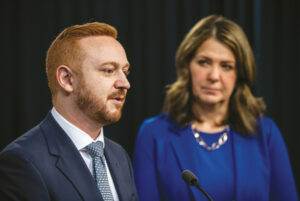
Justice Minister and Attorney General Mickey Amery says his government has been consistent approach to policies affecting Alberta gun owners: "We will not allow any program that creates criminals out of them."
zmason@medicinehatnews.com
The Alberta government announced Tuesday it is instructing provincial entities not to enforce the federal gun buyback program, using its Alberta Sovereignty within a United Canada Act.
The act is designed to address federal legislation that the province regards as interfering with provincial constitutional rights.
Provincial entities like municipalities, local law enforcement and RCMP will not receive support to facilitate the program.
In a media roundtable Wednesday, Justice Minister and Attorney General Mickey Amery said he most important takeaway from the announcement is that the province wants to make it clear they will not co-operate with federal counterparts for the implementation of the program.
“We’re not saying that the federal government cannot implement a gun buyback program. What we are saying is we certainly won’t dedicate our provincial resources to assisting them in doing so,” Amery told reporters.
Amery said the province will not stand in the way of Albertans who independently seek to participate.
Supreme Court decisions, including the results of a 1995 challenge issued by Alberta in response to the Firearms Act, have ruled that firearms ownership falls under the jurisdiction of parliament as it pertains to criminal law.
The motion contests this stance, describing firearms ownership as falling “within the exclusive legislative jurisdiction over property and civil rights,” which is the domain of the province.
Amery says his government doesn’t think the program will achieve the purposes the federal government says it is designed to perform. Still, he says the province is prepared to challenge the law in the courts if necessary.
In Alberta, less than 1 per cent of more than 374,000 firearms licence holders have had their licence revoked. Earning a firearms licence in Alberta also requires would-be licensees to undergo vetting and take a firearms safety course.
According to Statistics Canada data from 2023, 91 per cent of accused perpetrators in shooting homicides did not have a valid licence for the firearm they used.
“The thought of going after law-abiding Canadians, taking their guns and having some expectation that we’re going to see violent crime in this country drop is absolutely ludicrous,” said Amery.
The program was initially rolled out for businesses in 2020, before a pilot program for individuals was launched this fall in Cape Breton, N.S.
According to Amery, participation in the voluntary buyback pilot fell short of the expected benchmark by close to 90 per cent.
The nationwide program is scheduled to commence shortly, with amnesty extending through Oct. 30, 2026.
Amery says that with RCMP vacancy rates high across the prairies, he thinks asking understaffed detachments to enforce the buyback program is a poor use of resources.
The federal government has earmarked $742 million for the program. Amery thinks those funds could be put to better use.
“What I would like to see is $742 million being devoted to shoring up borders, being devoted to increasing law enforcement presence and maybe, at risk of being selfish, being provided to our Crown Prosecution services. These are the types of things that I think the federal government would be best served in doing if they wanted to address pubic safety in our country.”
Motion seeks to strengthen, clarify Albertans’ right to self-defence
The motion released Tuesday also contains directives for the Alberta Crown Prosecution Service related to the use of force in defence of self or property.
The motion advises prosecution services that “the use of reasonable force to defend oneself and others in one’s home will generally not be in the public interest.”
Amery told reporters Wednesday that the guidelines were developed in response to high-profile cases across the country where individuals responded to home invasions with force and faced charges.
He says the guidelines continue to operate within the parameters of the Criminal Code, which establishes that Canadians can use reasonable force to defend themselves or their loved ones when faced with an imminent threat.
The updated guidelines will ask prosecutors to consider context when evaluating a case of self-defence, including how quickly emergency services are likely to respond, a consideration Amery says is especially pertinent in rural or remote communities.
Amery says he thinks the new guidelines will create more consistency for Albertans who have been looking for clarity on what constitutes reasonable force and when it can be legally used.
Public Safety Canada did not respond to a request for comment in time for publication.