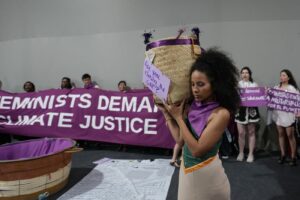
OTTAWA — Dozens of advocates for women and LGBTQ+ people in Canada and abroad are demanding clarity from the Carney government on its message shift on feminism.
In an open letter co-ordinated by Oxfam Canada, 92 organizations and 162 individuals say they’re deeply concerned by Prime Minister Mark Carney’s recent statement that Canada supports equality but no longer has a feminist foreign policy.
“Anti-rights actors are organizing and looking to roll back gains and make future progress more difficult. Women, girls and gender-diverse people are looking to Canada for support,” reads the letter, dated Monday.
“To back away from this position of leadership at a time of dramatic global rollbacks sends the wrong message to the world.”
Carney told reporters last month that while Canada no longer has an explicitly feminist foreign policy, his government is still upholding values that include defending LGBTQ+ rights abroad and combating violence against women — things he called aspects of Canada’s foreign policy.
“Yes, we have that aspect to our foreign policy, but I wouldn’t describe our foreign policy as feminist foreign policy,” Carney said on Nov. 30, during the G20 summit in Johannesburg, South Africa.
The comments mark a break from the foreign policy branding of former prime minister Justin Trudeau’s government. The Oxfam letter argues they “risk weakening the country’s long-standing leadership on gender equality, human rights, and multilateralism.”
The letter calls on Ottawa to commit to its decade-long pledge on sexual health and its multi-year plan to promote women in peace and security roles, and to continue funding programs that support LGBTQ+ people and women.
The advocates say they want Ottawa “to apply feminist analysis and incorporate specific gender-equality investments across all dimensions of Canada’s foreign policy,” including trade and defence.
The advocates are also asking Carney to reappoint an ambassador for women, peace and security, or WPS, after the role expired in March. Global Affairs Canada has since moved diplomat Jacqueline O’Neill, who held the role, into an internal role touching on transnational conflict.
WPS diplomacy recognizes the disproportionate impact of war on women and girls and promotes their leadership in peacebuilding and conflict prevention. Canada has championed WPS since Stephen Harper’s Conservative government was in power.
Ottawa has used the envoy role to learn from other countries’ domestic policies on problems such as police discrimination against Indigenous women.
The Trudeau government created a WPS ambassador position in 2019, noting at the time that Ottawa had “developed a reputation for leadership” in the field while acknowledging that the concept faced “powerful backlash” abroad.
The Oxfam letter says that backlash has worsened in recent years.
“With human rights under attack in many regions, civil society leaders argue that Canada has both the opportunity and responsibility to respond,” the group wrote. “Anti-rights movements are organizing across borders, seeking to roll back progress on gender equality.”
The letter’s signatories include Amnesty International, the Canadian Women’s Foundation and various unions.
Since Carney made his comments, MPs and senators have called on Foreign Affairs Minister Anita Anand to state whether specific feminist programs are on the chopping block as the Liberals look to reduce spending.
Anand echoed Carney’s claim that Canada still advances feminism at home and abroad, noting progress with other countries on training female peacekeepers. Her own main speech to the United Nations last fall listed values as a third pillar of Canada’s foreign policy, alongside economic security and defence.
“We are going to make sure that our commitments to gender equality, human rights women and girls will continue in a way that recognizes the new geopolitical and fiscal context, both of which demand a different frame,” she told the House foreign affairs committee on Nov. 27.
Sen. Mary Coyle and Bloc Québécois MP Alexis Brunelle-Duceppe said they did not feel Anand explained why Carney felt the need to shift away from feminism, or the impact this will have on existing projects and funding.
This report by The Canadian Press was first published Dec. 2, 2025.
Dylan Robertson, The Canadian Press